The short answer: Hermès watches are Swiss, and they are Swiss by the maison's own choice, not under licence. Since 1978 there has been La Montre Hermès, the group's own company, which designs and assembles them in the Biel area. That is the difference from almost every other fashion house, which rented its name to an outside manufacturer. The story, though, does not begin in 1978, and not with a watch either: it begins in 1912, with a piece of leather.
In 1912 Émile-Maurice Hermès, the founder's grandson, had a porte-oignon made for his daughter Jacqueline: a leather holder that carried a pocket watch on the wrist. Jacqueline rode, and a watch in a pocket was impractical; the holder followed the watch's shape and curve to protect it. Hermès treats it as the first of its objects to do with time.
You will often read that it was «the world's first wristwatch». That is not established, and the more careful sources stop at a «perhaps». What is documented is simpler: this house came to watches from leather, not from movements. In 2012, a hundred years later, it remade the object as the In The Pocket model.
The first watches with the Hermès name on the dial date from 1928. For half a century the house did not build them: it had them built. Auction records and period catalogues show cases and movements from Jaeger-LeCoultre, Vacheron Constantin, Movado and Universal Genève. This was not unusual: it is how almost every fashion house that sells watches has worked.
The difference comes fifty years later, and it is about who owns the factory.
In 1978 Jean-Louis Dumas, the founder's great-grandson, set up La Montre Hermès: a group company with a plant in the Biel area of Switzerland, created to produce watches for the Hermès network. Sources say Biel; some say the neighbouring municipality of Brügg. From that year the watches are no longer only commissioned: they are designed and assembled in house.
This is what separates Hermès from almost every other fashion house. Gucci, to take the example closest to us, licensed its name to an outside company, and for twenty-five years Gucci watches were made by others under that name. Hermès did the opposite: it built its own company in Switzerland and then bought its suppliers.
In 2006 it took a 25% stake in Vaucher, a movement manufacture in Fleurier; later it absorbed Natéber, which made its dials, and Joseph Erard for cases. For the vintage we handle this matters little technically — the Eighties and Nineties models almost always carry bought-in Swiss quartz movements — but it explains why the Hermès name on a dial is not a rented trademark.
Read how it went with Gucci instead
Five names cover almost everything you meet on the second-hand market. The dates are those of the design, not of production: many of these families stayed in the catalogue for decades.
The list updates itself and shows only the pieces available right now.
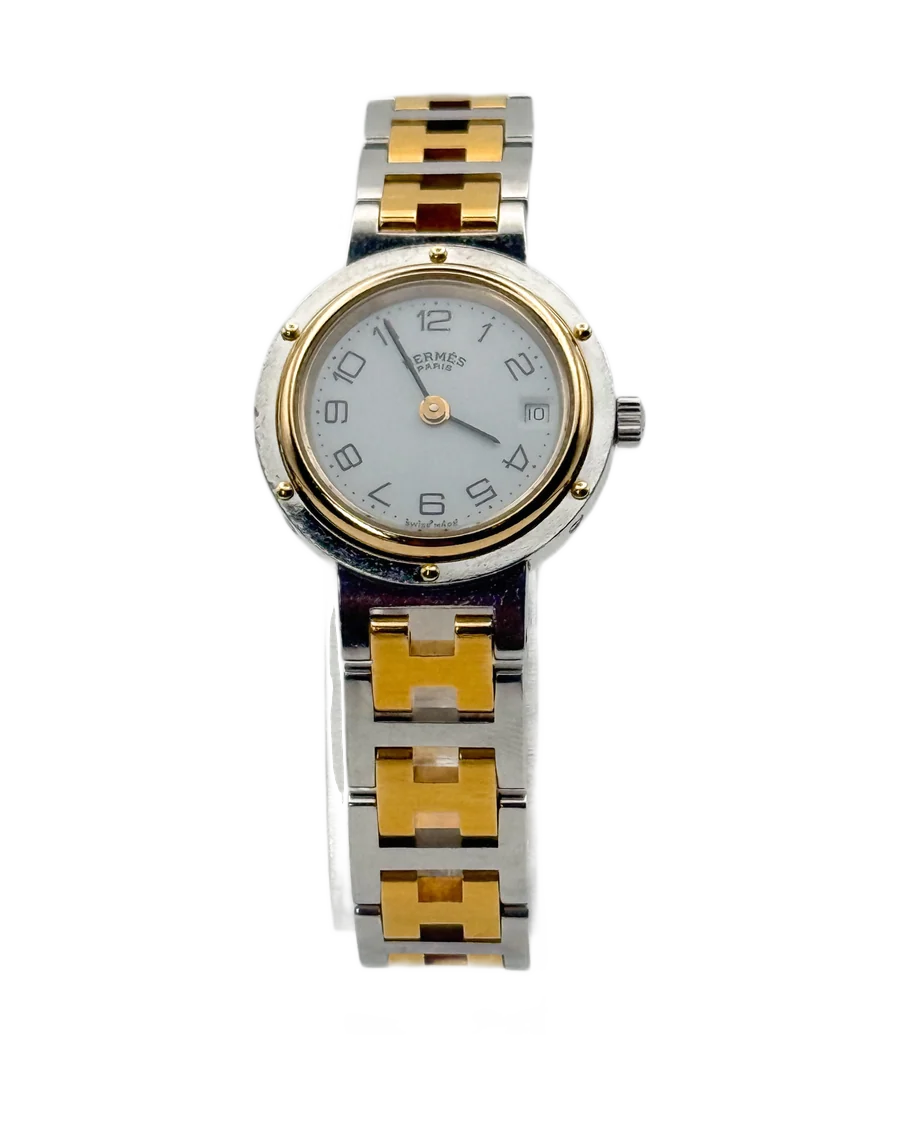
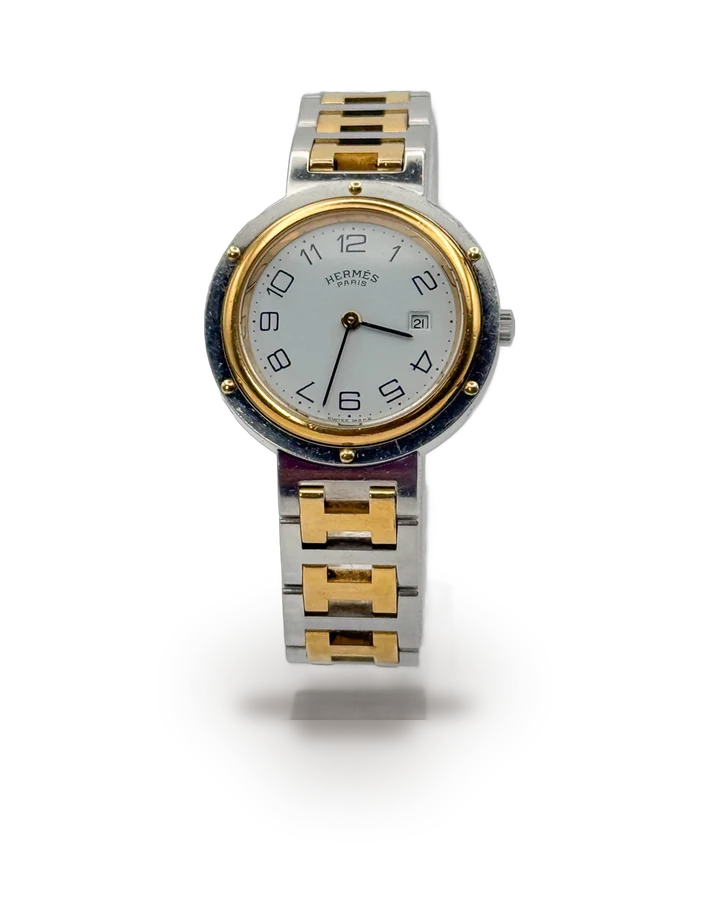
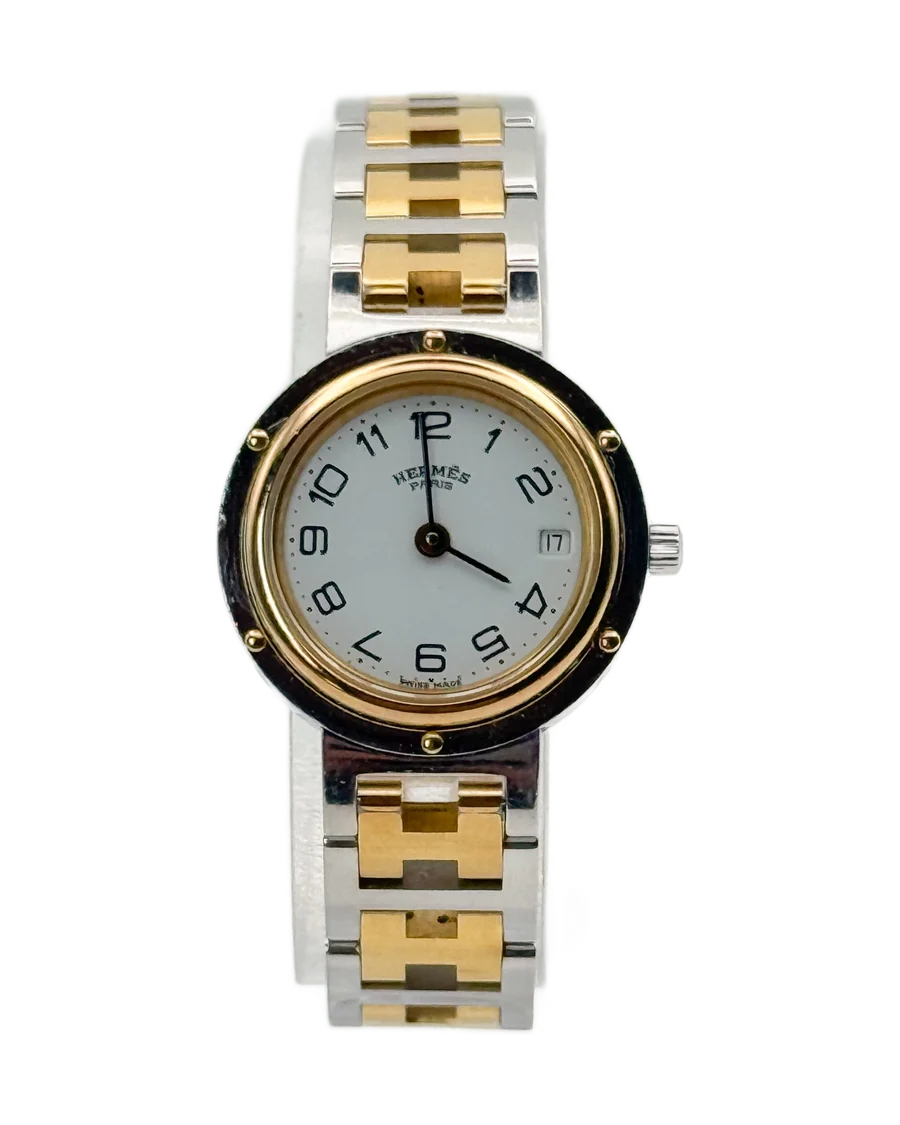
This is the Hermès model you meet most often, and the easiest to recognise: a round case, a bezel with exposed screws, a date window at three o'clock. The design is from 1981 and is by Henri d'Origny; the bezel quotes a ship's porthole, the name the sailing ships.
It comes in steel and in two-tone steel and gold plate, in several sizes — between 24 and 30 mm on our cards — on a link bracelet or on a strap. The original two-tone bracelet is the part that wears first: the plating goes from the edges of the links, where the hand rubs.
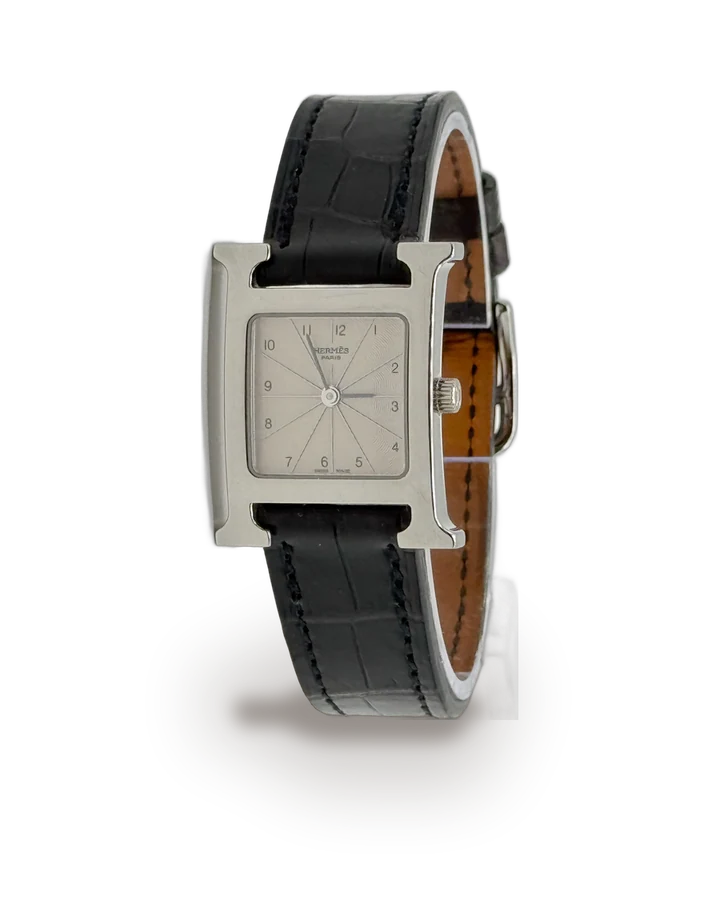
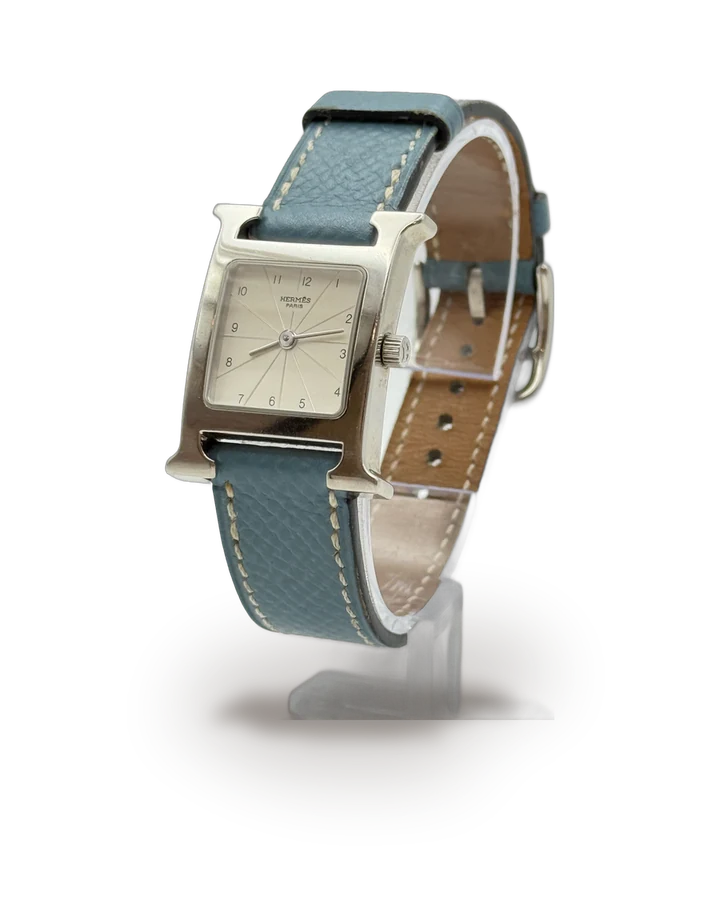
Designed in 1996 by Philippe Mouquet. There is a single idea, and you see it at once: to fit time inside the maison's initial. The case is an H, and its two uprights serve as the strap attachments.
It is the easiest model to wear on a slim wrist: in the PM version our cards measure it at 21 mm. It comes in steel and in gold plate, almost always on an Hermès leather strap.
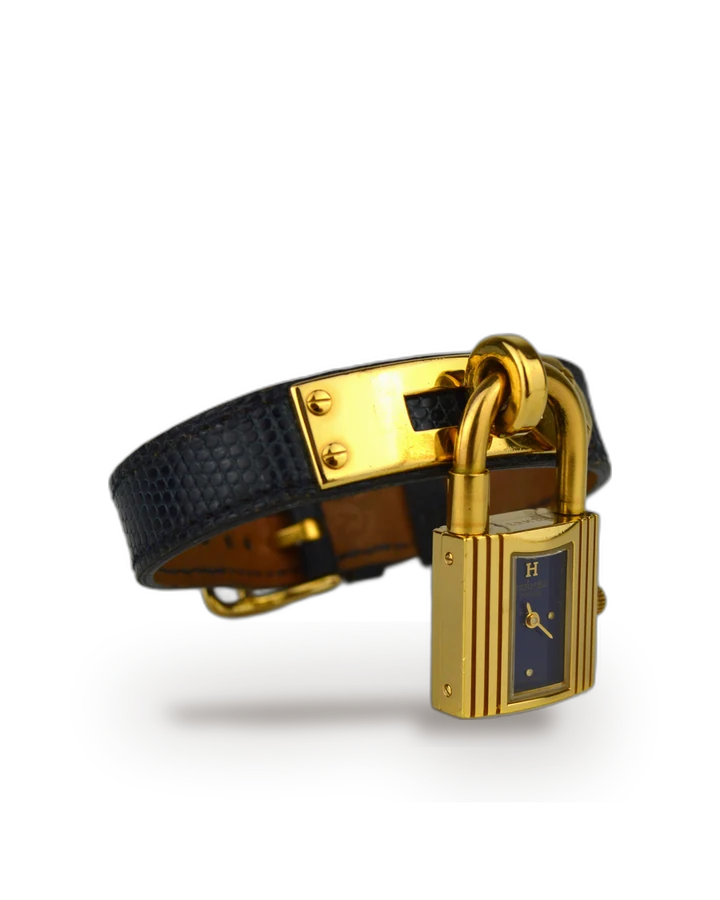
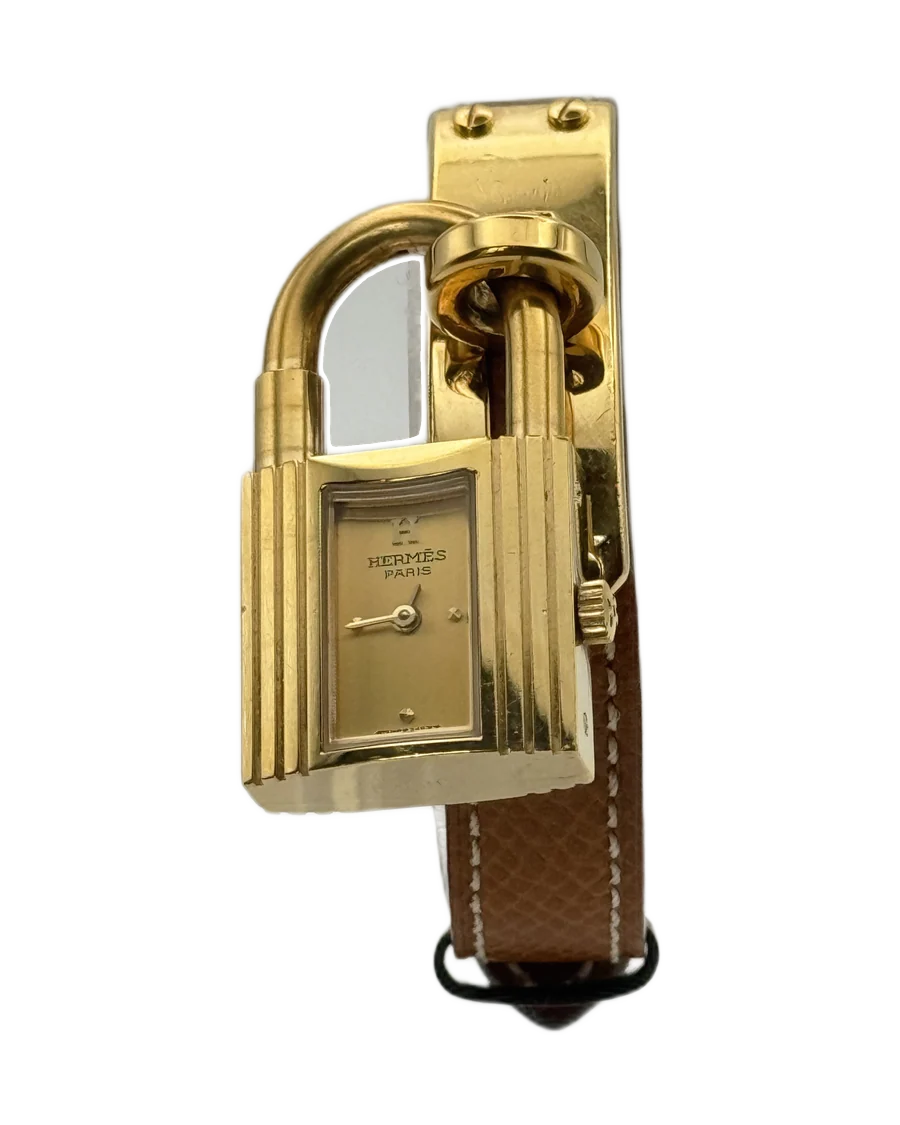
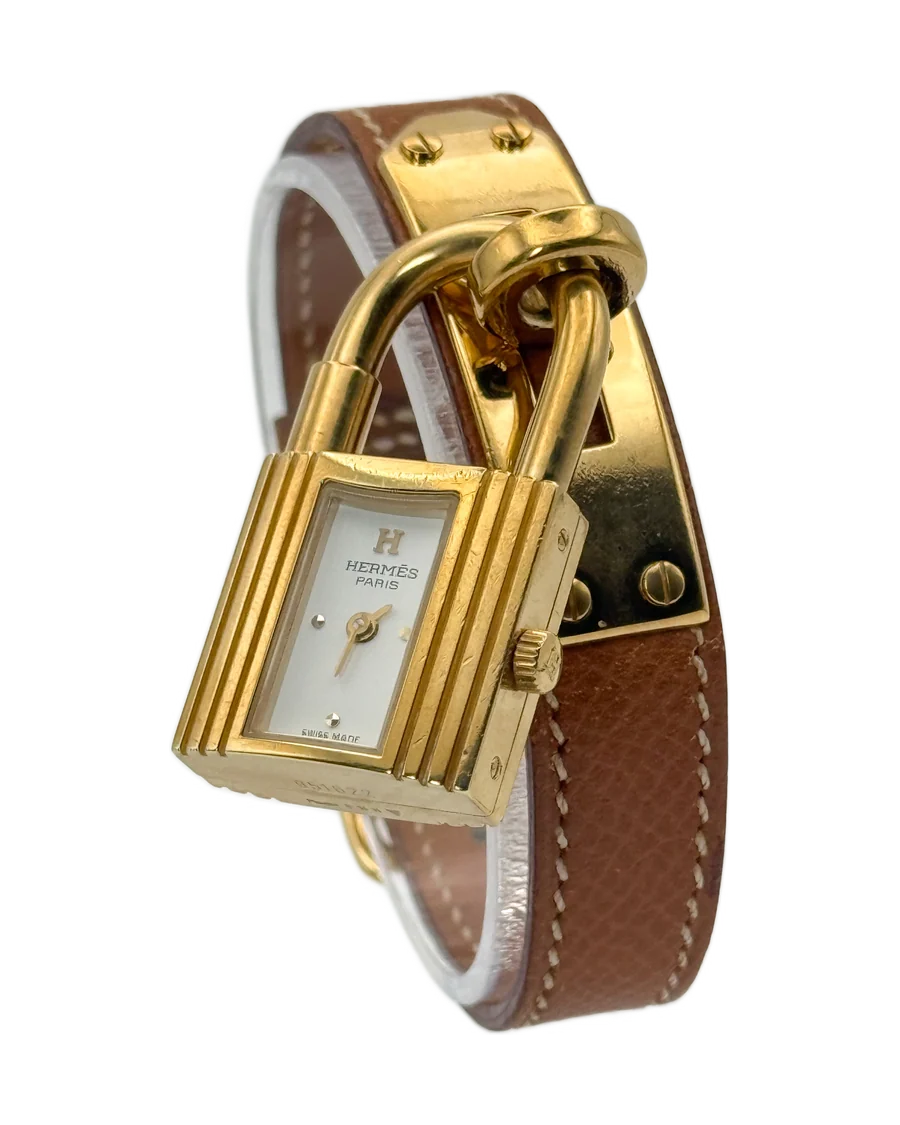
In 1975 Hermès took the cadenas — the padlock that closes the Kelly bag — and made a watch of it: the padlock is the case, it opens and the dial is inside. The strap echoes the bag's side straps.
It is the one Hermès of ours that does not read as a watch at a glance: closed, it looks like a piece of jewellery, and people who look for it usually look for it for that reason.
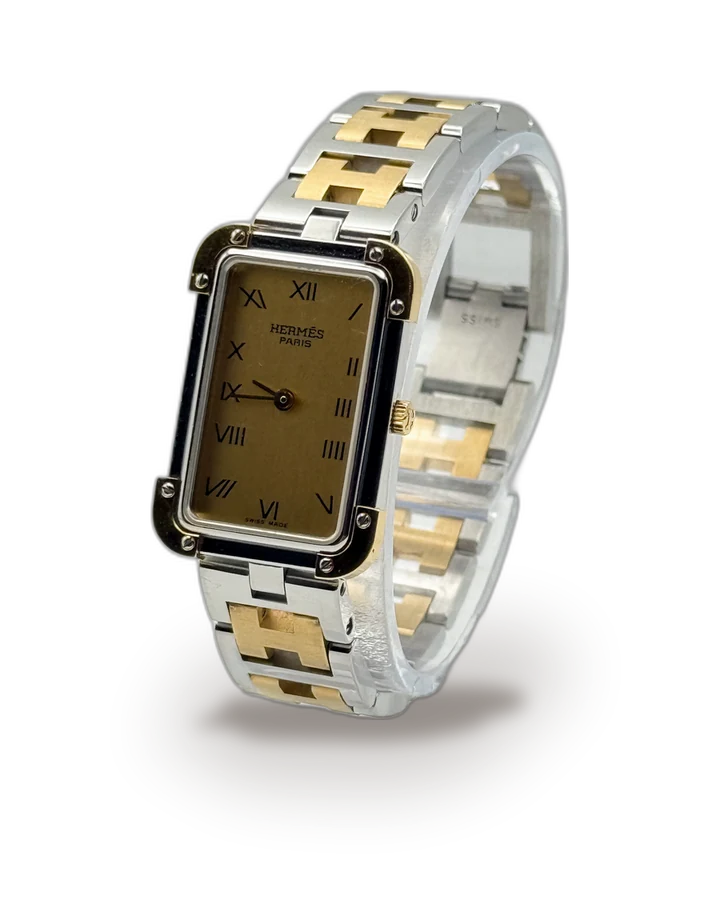
Not every model has a documented history. For the Croisière — rectangular, two-tone, Roman numerals, CR1-series references — we found neither a launch date nor a designer in a reliable source. Sellers place it between the Eighties and the Nineties, and for now that is all that can be said.
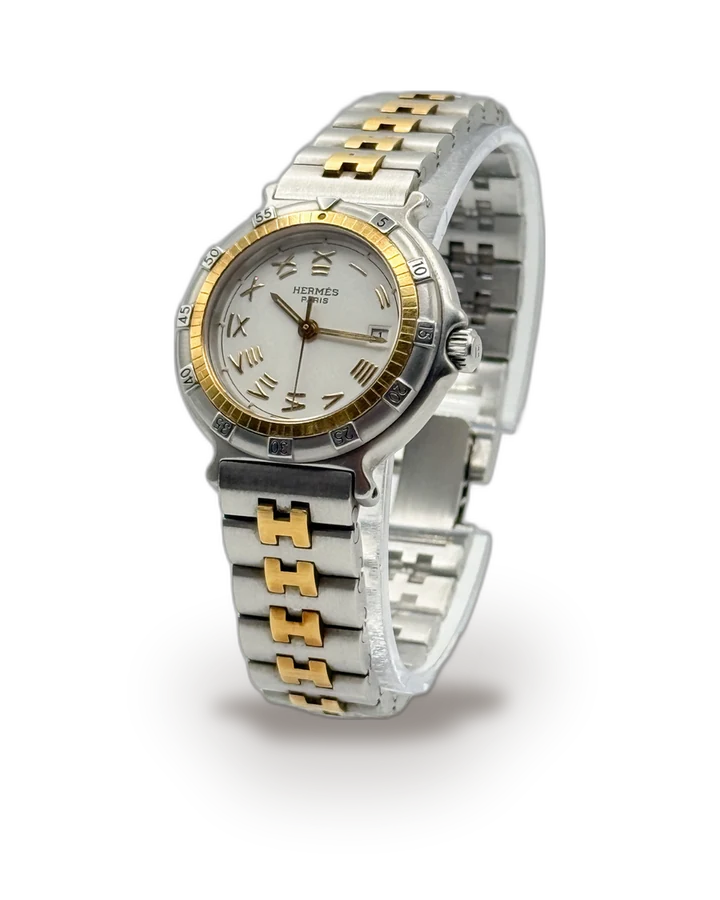
The same holds for the Captain Nemo, recognisable by its graduated rotating bezel. Listings date it to the Nineties and do not even agree on whether it belongs to the Clipper family.
We write this down because it is how we work: where there is no source, we do not put a date.
See all the available Hermès watches
Yes. Since 1978 they have been designed and assembled by La Montre Hermès, a group company with a plant in the Biel area. Before that the house had them produced by outside Swiss firms, among them Jaeger-LeCoultre and Vacheron Constantin.
No, and that is the main difference. Other fashion houses rented their name to outside manufacturers; Hermès created its own company in Switzerland and over the years bought the suppliers of its dials and cases, as well as a stake in the Vaucher movement manufacture.
Often it cannot be said. The references stayed in production for years and case numbers are not public. On our cards the year appears only when it is documented, usually from the warranty booklet.
Hermès did produce Clipper divers, but these are not those. The models that pass through our hands are women's quartz watches: the bezel is a design element and water resistance, after thirty years, is not a guarantee. We do not recommend getting them wet.
